
Emergency Air Duct Cleaning Near Me: What Corona Homeowners Should Do First
If you’re searching for “emergency air duct cleaning near me” in Corona, the honest answer is that most situations feel urgent but aren’t a cleaning emergency at all. A sudden smoke smell, musty odor, or visible debris at a register needs triage first, not an immediate cleaning appointment, because chasing the symptom without identifying the source can delay the real fix and even spread the problem. Before you book anyone, shut down the HVAC system and take ten minutes to observe what’s actually happening. If you’d rather not sort through it alone, call (855) 923-0983 and we’ll talk you through the symptoms over the phone.
Why Most Duct “Emergencies” in Corona Aren’t Cleaning Emergencies
Here’s the thing we wish more Corona homeowners knew before they call: the duct system is a delivery network, not a source. Air moves through it, but the ducts don’t create odors, smoke, or pests on their own. When a homeowner smells something alarming coming from the vents, the ducts are often just carrying that smell from somewhere else, the air handler, the attic, a crawl space, a return-air pathway, and cleaning them without finding the origin means the problem comes right back.
We run into this all the time. A homeowner calls Duct Cleaning Corona convinced the ducts are the culprit, and often the real issue is something upstream. That’s not a knock on the homeowner, it’s just how airflow works. Air takes the path of least resistance, and in a Corona summer, when the AC runs hard from late morning through evening, anything smoldering, off-gassing, or decaying near the return side gets pulled through the whole system fast.
The practical takeaway: don’t call a duct cleaner first. Call whoever can diagnose what you’re observing. If we’re the right call, we’ll tell you. If we’re not, we’ll tell you that too. A contractor who books an “emergency cleaning” without asking what you’re seeing and smelling is selling you a service, not solving your problem.
The First Thing to Do: Shut Down and Document
Whatever symptom you’re facing, the first step is the same for every Corona home: turn the HVAC system off at the thermostat and set the fan to “auto” or “off.” Do not run it while you investigate. If the odor is smoke or something burning, running the fan while you wait for a contractor circulates whatever is burning through every room. If it’s mold or chemical off-gassing, the same applies, you’re actively spreading the contaminant.
Once the system is off, document what you’re observing. Take photos at each register you can reach, but pay special attention to the return-air grille and the air handler itself. Note the following:
- Which rooms have the symptom and which don’t, airflow problems often follow a pattern
- Whether the odor is constant or only present when the system has been running for a while
- What color and texture any visible debris is, greasy, sooty, powdery, or fibrous all mean different things
- When you first noticed the issue and what changed in the home in the days before: new paint, new furniture, roof work, pest activity, a recent remodel
Those notes matter more than you’d think. When a technician arrives and you can say “it started Tuesday, it’s strongest in the two west-facing bedrooms, and the debris at the register is greasy rather than dusty,” diagnosis moves much faster than “it smells weird.” In our experience, the homeowners who document symptoms get answers faster and avoid paying for work that wouldn’t have fixed the real issue.
Four Common Corona Duct Emergencies and the Right First Call
These are the four scenarios we hear about most often from Corona homeowners who call us in a panic. Each one has a different correct first move, and it’s usually not duct cleaning.
1. Smoke or Burning Odor from Vents
Correct first call: an HVAC technician, not a duct cleaner. A burning smell means something is overheating or actively smoldering, and that’s an equipment problem. The usual suspects are a failing blower motor, a capacitor going bad, or an electrical connection deteriorating inside the air handler. Running the system to “see if it clears” can turn a repair into a fire. Shut it down, call an HVAC tech, and if they find that the event blew soot or residue through the duct work, that’s when you call us to clean up the aftermath.
2. Sudden Musty or Moldy Smell
Correct first call: depends on where the moisture is coming from. A moldy smell from vents means moisture somewhere it shouldn’t be, and in Corona‘s dry climate, that’s usually a specific failure rather than ambient humidity. Look for condensation on the air handler, a clogged condensate drain pan, or a small leak near the return. If you can see obvious microbial growth on or inside the air handler, a mold remediation specialist is the right first call. If the smell is musty but you can’t find visible growth, a qualified duct cleaning contractor with proper containment equipment can inspect and clean where appropriate. But anyone who promises to “kill mold” with a chemical spray without addressing the moisture is treating the symptom, so ask where the water is coming from before you pay for anything.
3. Visible Debris or Pest Material at Registers
Correct first call: it depends what the debris is. If you see rodent droppings, nesting material, or insect casings at a register, call an exterminator first. Cleaning ducts full of pest waste before removing the pests is a waste of money, and pest debris is a serious contaminant that requires careful handling. If the debris is dust, insulation fibers, or drywall dust from a recent project, that’s a legitimate air duct cleaning call, and in Corona’s older track neighborhoods, we see plenty of it. Homes built decades ago often have duct work that’s never been thoroughly cleaned, and years of accumulated dust, pet dander, and construction debris finally migrating to the registers can look alarming but cleans up well.
4. Chemical Odor After Renovation
Correct first call: usually none, with time and ventilation. If you just had floors refinished, cabinets painted, or drywall work done, the volatile organic compounds from those materials off-gas for days or weeks. They get pulled into the return air and distributed through the home, making it smell like the renovation is inside the duct system. It usually isn’t, at least not permanently. Run the system with fresh filters after the work is fully cured and ventilated, and if the smell persists beyond what’s reasonable for the materials used, then talk to us about cleaning the residual dust and particulates out of the duct work.
What a Legitimate Duct Cleaning Contractor Should Ask Before Booking
One of the easiest ways to tell whether you’re talking to a real professional or a sales script is how many questions they ask before quoting a price. A contractor who agrees to “emergency duct cleaning” without asking what you’re seeing, smelling, or experiencing is skipping triage, and triage is the whole job.
When you call us about a time-sensitive duct issue in Corona, here’s what we want to know before we’ll book anything:
- What symptoms you’re observing and when they started
- Whether anything changed in the home recently, renovation, new pets, pest activity, roof work
- The approximate square footage of the home and whether it’s one or two stories
- The type of duct material if you know it, flexible duct, rigid sheet metal, or duct board
- The age of the HVAC system and whether the filter has been changed recently
- Whether you’ve already had anyone else inspect the issue
None of these are gatekeeping questions. They’re diagnostic. A homeowner who says “sudden burning smell, started this morning, strongest at the air handler” has a different problem than one who says “dusty smell for months, worse in the bedrooms.” The first needs an HVAC referral. The second is probably a cleaning job, and one we’d treat with the same equipment rigor we bring to every Corona home, professional-grade Rotobrush and Nikro systems, not shop-vac workarounds, with proper negative-air containment when the situation calls for it.
What Actually Qualifies as a Duct Cleaning Emergency
Now that we’ve covered what isn’t a cleaning emergency, let’s be clear about what is. In our experience serving Corona homes since 2012, these are the situations where waiting 48-72 hours for a standard appointment creates measurable risk:
- Post-fire or smoke event: if a kitchen fire or electrical fire put smoke through the home, that residue is acidic and corrosive. It needs to be removed from the duct work quickly, not just the surfaces you can see.
- Post-pest infestation: once an exterminator confirms the pests are gone, the droppings and nesting material left in the ducts are a health concern that shouldn’t sit for weeks.
- Flood or water intrusion into duct work: if a water heater leaked into a return duct or an attic pipe burst over flex duct, that’s a time-sensitive issue. Standing moisture in duct work grows microbial activity fast.
- Confirmed hazardous material release: asbestos abatement in an older Corona home, fiberglass insulation disturbed into a return, or a chemical spill near an intake vent, any of these justify immediate cleaning to remove the contaminant from the airflow path.
Everything else, a dusty smell in a home that hasn’t had ducts cleaned in a decade, mild allergy symptoms, slight airflow imbalance, can wait a few days without meaningful consequence. The scheduling pressure you feel is often more about wanting the problem solved than about actual property or health risk. That’s a normal human response, and a good contractor will tell you so rather than exploiting it.
What We Actually Do on a Corona Duct Cleaning
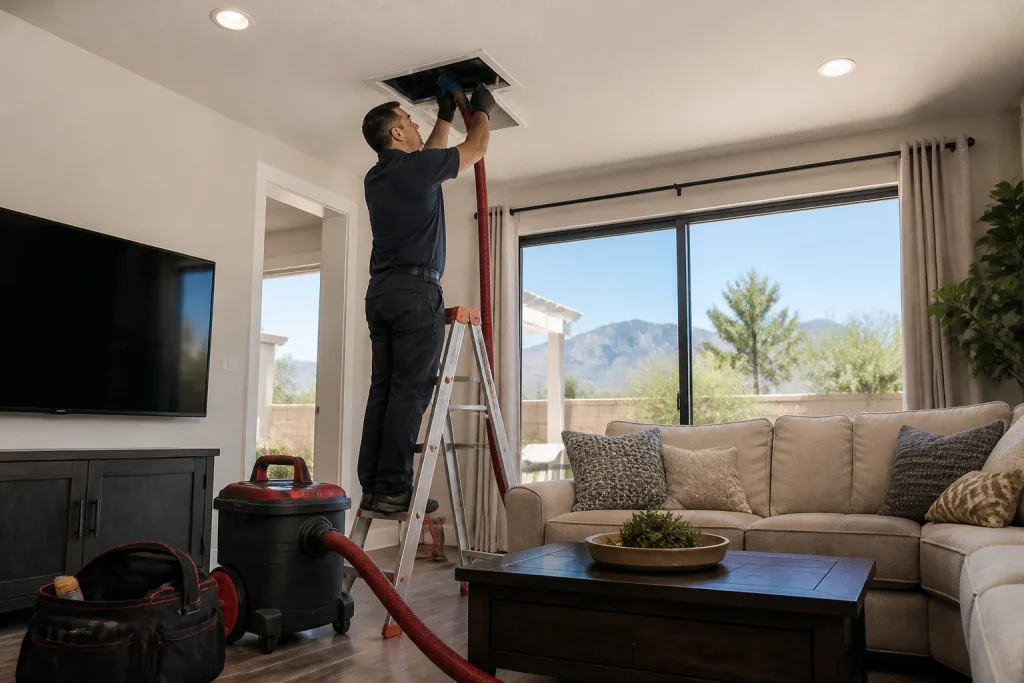
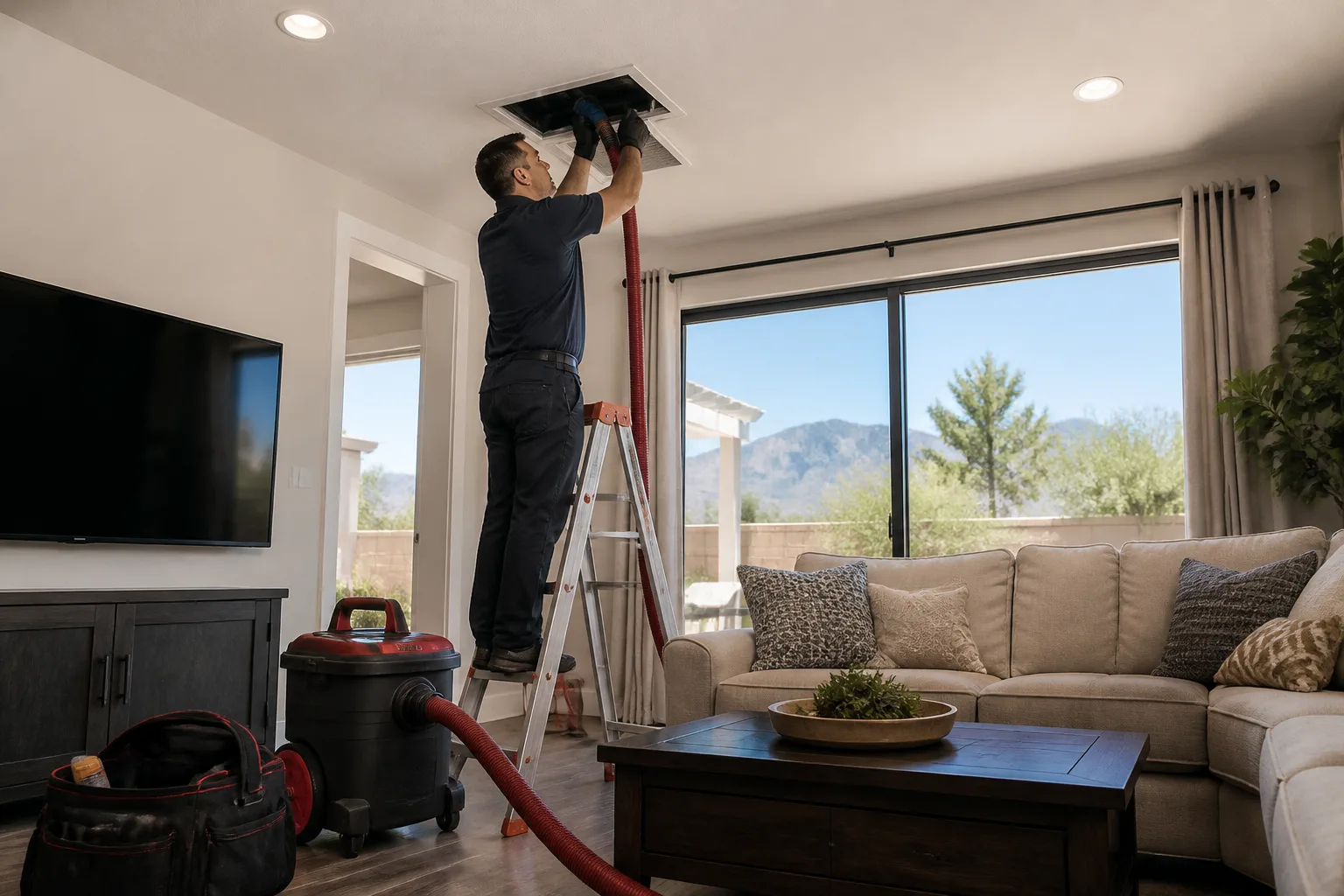
In the interest of demystifying the work, here’s what a proper air duct cleaning looks like when we do it. We don’t roll up with a household shop vac and a telescoping brush. We use Rotobrush and Nikro systems, purpose-built negative-air and agitation equipment designed specifically for duct work. That matters because household equipment can’t create the airflow needed to actually extract debris from long duct runs, and a cleaning that loosens debris without removing it just relocates the problem.
When the job calls for it, we use Abatement Technologies containment and negative-air equipment. That means the air pressure inside the home is managed so that whatever we dislodge during cleaning exits the home through a filtered exhaust, not back into your living room. It’s the same standard used in asbestos and mold remediation work. Most Corona homes don’t need full containment for routine cleaning, but when they do, we have the equipment on the truck, and that’s the difference between a cosmetic cleaning and an actual contaminant removal.
We also approach every job with a simple offer most duct cleaners won’t make: if we find compromised duct work during the job, disconnected joints, crushed flex, rusted through sheet metal, we can repair it in the same visit. Dryer vent cleaning is another service we handle with the same rigor, and it’s worth saying plainly: a clogged dryer vent is a fire hazard, and in Corona homes where laundry rooms sit adjacent to living spaces, the risk isn’t theoretical. We treat it as the safety service it is, not a footnote on an invoice.
When to Call a Pro
If you’ve shut the system down, documented what you’re seeing, and the picture is still unclear, that’s exactly when a professional’s triage questions add real value. You don’t need to know whether it’s an HVAC issue or a duct issue before you call, that’s what we’re paid to sort out over the phone. What you need is a contractor who starts with questions and ends with a scoped recommendation, not one who starts with a schedule and ends with an invoice. Call Duct Cleaning Corona at (855) 923-0983 and we’ll ask the right questions before anything gets booked. We answer 24/7. Fast dispatch from 7am to 7pm, Sunday through Friday.
The Bottom Line
Most “emergency air duct cleaning” searches in Corona start with a scary symptom and end with a simple answer. Shut the HVAC off, take photos, note when the problem started, and make the right first call based on what you’re observing, which is often an HVAC tech, exterminator, or remediation specialist before a duct cleaner. A real duct cleaning company will help you triage rather than rushing you into a service. If the ducts are genuinely the right call, the work should be done with professional-grade equipment, proper containment where needed, and a contractor who can also repair what the cleaning reveals. If you’re in Corona and need help sorting out what’s going on, call (855) 923-0983 for a free estimate. We answer 24/7. Fast dispatch from 7am to 7pm, Sunday through Friday.
Frequently Asked Questions
Shut the HVAC system off at the thermostat immediately and do not run it while you investigate. A smoke or burning odor from vents is almost always an equipment problem, not a duct issue, so your first call should be to an HVAC technician. Running the fan while you wait circulates whatever is burning through every room. If the event pushes soot or residue through the duct work, that’s when you call Duct Cleaning Corona to clean the aftermath. Call (855) 923-0983 if you’re not sure which step applies to your situation.
As soon as the source is confirmed safe and the structure is cleared for occupancy. Smoke residue is acidic and corrosive, and it doesn’t just sit on surfaces, it works into them over time. The faster the residue is extracted from the duct work, the less permanent damage it does to the system and the less odor it leaves in the home. A professional cleaning with proper equipment and containment is the standard here, not a household-grade or chemical-only approach.
Only after the moisture source is identified and corrected. If you can see visible growth on or inside the air handler, a mold remediation specialist should be your first call, because cleaning alone won’t solve what’s feeding the growth. If the smell is musty but you can’t find the source, a qualified duct cleaning contractor with containment equipment can inspect and clean where appropriate. Be wary of any company that promises to spray chemicals to “kill mold” without discussing where the water is coming from.
Know the approximate square footage of your home, whether it’s one or two stories, the type of duct material if you know it, the age of your HVAC system, and a clear description of when the symptom started and what changed in the home beforehand. Recent renovations, pest activity, roof work, or new pets are all relevant. A contractor who asks these questions before quoting is doing triage properly, and that’s a good sign. Call (855) 923-0983 for a free estimate and we’ll ask the right questions up front.
Written by the team at Duct Cleaning Corona, serving Corona since 2012.
Need Air Duct Cleaning Help?
Call Duct Cleaning Corona - licensed & insured, with free written estimates in Corona.
(855) 923-0983